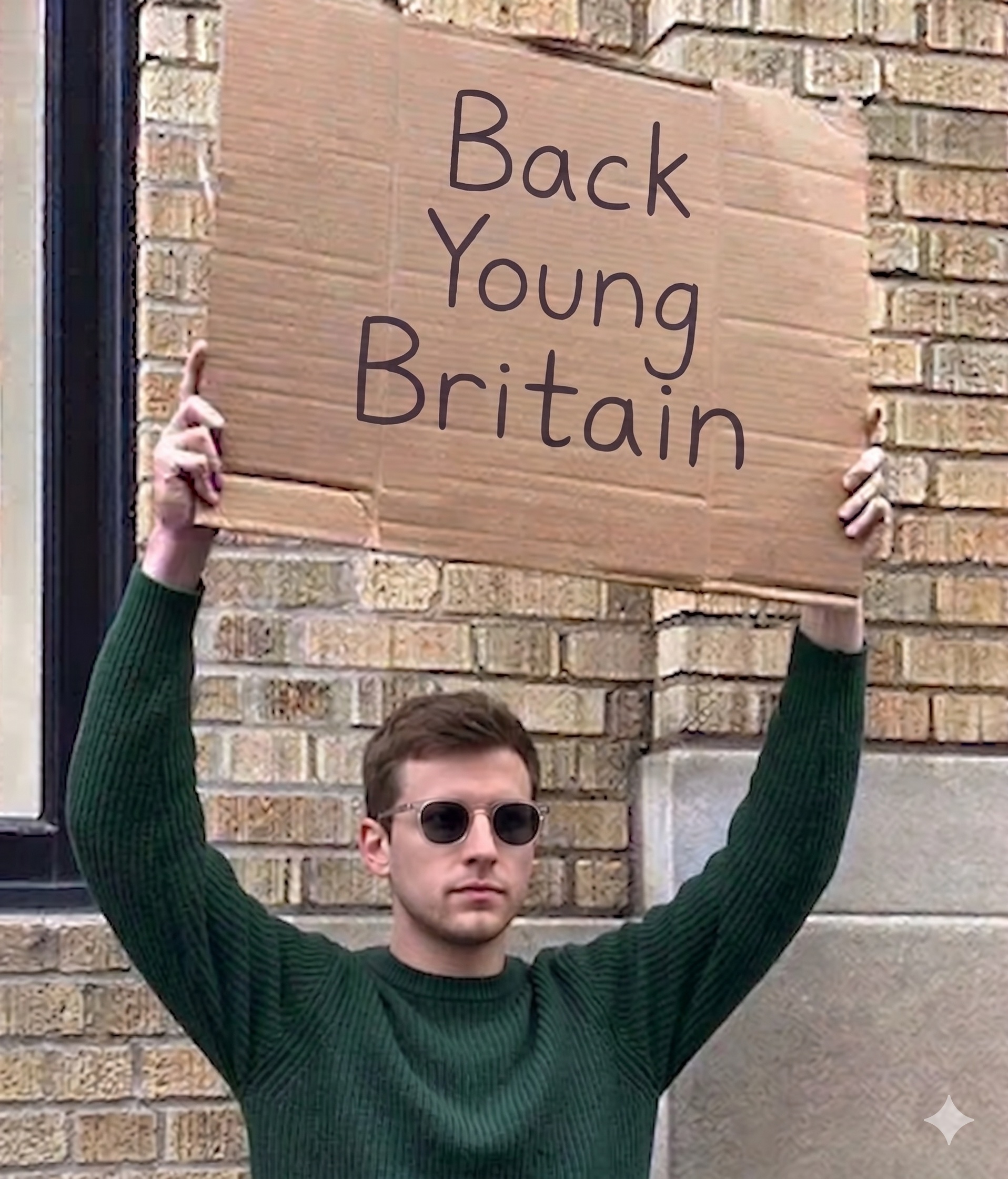
A campaign for Britons under 30

Britain is home to some of the brightest and most ambitious young people in the world, yet across education, employment, housing and health, they are being let down.

Back Young Britain

See how young people are faring in your local area, and add your name to our open letter calling on the Government to start Backing Young Britain.

Back Young Britain
Net emigration of 16–34 year olds in 2025.
Top destinations:
Dubai, Australia, Canada.
111,000
Source: ONS
The house price-to-earnings ratio in England.
It was 3.5x in 2000.
7.6x
Source: ONS Housing Affordability
Under-25s with a mental health condition.
2x from a generation ago.
1 in 5
Source: NHS Digital
Owed by the average graduate before they earn a penny.
Up from £9,000 in 2006.
£53K
Source: House of Commons Library

In education

The education system is failing young people at each stage. School absence is nearly double pre-pandemic levels. College funding has only just returned to where it was a decade ago. And graduates leave with £53,000 of debt, into one of the highest-debt systems in the world (UNESCO).

The promise was the great equaliser. The reality is underfunding, disengagement, and debt.

Primary & Secondary Schools
10% 8% 6% 4% 2% 0% 2013-14 2015-16 2017-18 2020-21 2022-23 2024-25 COVID 4.51% 7.55% 6.78%
Overall absence rate
25% 20% 15% 10% 5% 0% 2013-14 2015-16 2017-18 2020-21 2022-23 2024-25 COVID 10.50% 22.51% 18.14%
Persistent absentees (10%+ sessions missed)
3.0% 2.0% 1.0% 0% 2013-14 2015-16 2017-18 2020-21 2022-23 2024-25 COVID 0.57% 2.39%
Severe absentees (50%+ sessions missed)
College & Sixth Form
£9,000 £8,000 £7,000 £6,000 £5,000 2009-10 2013-14 2017-18 2021-22 2025-26 £8,272 £5,773 £6,595
Per student funding — Sixth Forms (ages 16–18)
£9,500 £8,500 £7,500 £6,500 2009-10 2013-14 2017-18 2021-22 2025-26 £8,821 £7,163 £7,860
Per student funding — Colleges (ages 16–18)
University
£60k £40k £20k £0 1999-00 2004-05 2009-10 2014-15 2019-20 2024-25 £9K FeesIntroduced £2.7k £53k
Avg. debt on entering repayment
£300bn £200bn £100bn £0 2002-03 2006-07 2010-11 2014-15 2018-19 2022-23 £7.8bn £267bn
Total outstanding balance
£250 £200 £150 £100 £50 £0 2013-14 2015-16 2017-18 2019-20 2021-22 2023-24 £222/mo £73/mo
Interest added per borrower
Repayment per borrower

In employment

Work hard, get ahead. Yet, the jobs young people were promised are vanishing.

AI is eliminating entry-level roles. Rising employer NICs have made hiring juniors 7% more expensive (BCC). Apprenticeship starts for under-25s have fallen nearly 40% in a decade. And 1.2 million graduates applied for just 17,000 roles (Forbes).

NEETs
1.05m 937k 825k 712k 600k 2019 2020 2021 2022 2023 2024 2025 COVID 673K 957K
16–24 year olds NEET (seasonally adjusted)
Unemployment
18% 15.5% 13% 10.5% 8% 2019 2020 2021 2022 2023 2024 2025 COVID 10.1% 16.1%
16–24 unemployment rate (seasonally adjusted)
550k 450k 350k 250k 150k 2016 2017 2018 2019 2020 2021 2022 2023 2024 2025 2026 COVID 161K 532K 329K
18–24 claimant count (seasonally adjusted)
Apprenticeships

In housing

It was never the avocados. House prices have more than doubled relative to earnings since the late 1990s. London saw just 5,547 housing starts last year, down over 75% (Bloomberg). And 3.6 million 16–34 year olds are living with their parents, over a million more than in 2005.

Buying
In England, the median house price was 7.6x the median salary in 2025, up from 3.5x in 1997.
Renting
In the UK, average monthly rent for 1 bedroom in a 2 bed flat (before bills) was £610 in 2025, up 61% versus 2010.
This represents 26% of a median 22–29 year old’s take-home pay.
House Building
In England, 208,600 net additional dwellings were added in 2024-25, just 56% of the government target of 370,000.
Living at Home
In England, there were 3.6 million 16–34 year olds living at home with their parents in 2024, up 1.05M since 2005.

In health

One in five children now has a diagnosable mental health condition, double what it was a generation ago. Over half a million are on a waiting list for support (BMA). Youth services funding has been cut by 76% in real terms since 2010 (YMCA).

They were promised a safety net, and what they got was a waiting list.

Mental Health Condition
In England, 1 in 5 children had a probable mental health condition, such as anxiety and depression, in 2023, up 50% from 2017.
Referrals to Completions
In England, 1.81 million people were referred for mental health support in 2024-25, with 670K successfully completing treatment, a gap of 1.14 million people.
Youth Services Funding
In England, local authority spending on youth services (such as clubs, sports and playgrounds) per young person was £37.43 in 2024-25, down 48% from 2012-13.

Add your name

Your name will be included in our open letter to the Government. We will not share your data with any other third parties. By signing, you agree to receive campaign updates.

We believe the UK Government should start Backing Young Britain and we will deliver our campaign directly to Number 10.
Join us and add your name to call for:

1. National Strategy for Young People: Requiring government to deliver targets for under-30s across education, employment, housing, and health.

2. Commissioner for Young People: An independent voice to hold government accountable on the issues shaping the lives of those under 30.

3. Generational Impact Assessment on all major legislation: So no law passes without asking: what does this mean for the next generation?